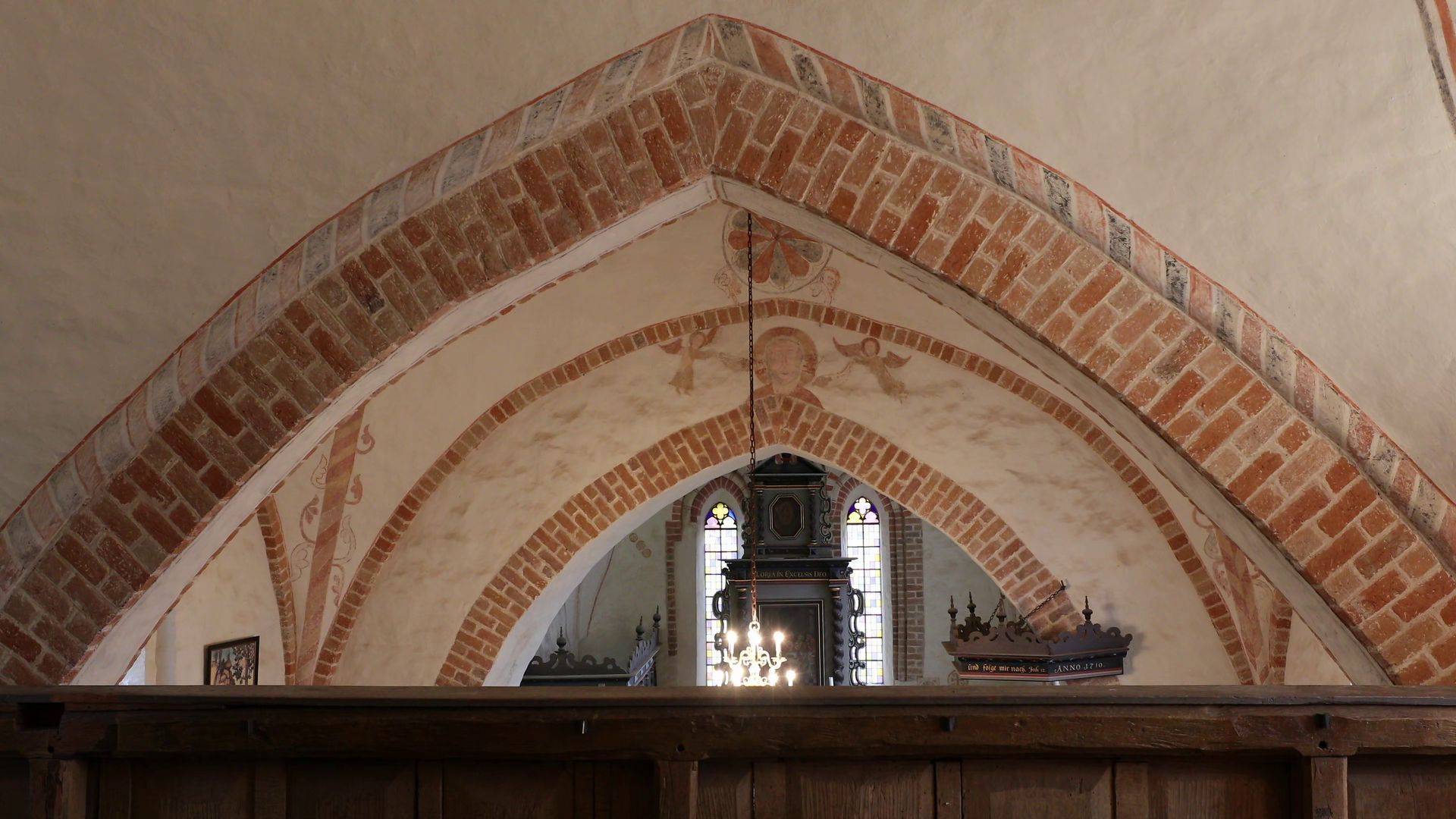
Various phases of building and painting have left their traces. Over the centuries the von Voß family left its mark on the history of Groß Gievitz.
-
(1) In the early 13th century, the area around Waren was still very sparsely settled by a number of Slavic peoples known as the Wends. Gradually German settlers arrived.
Groß Gievitz was laid out by Westphalian knights and peasants. The first parishes were created in around 1230 AD. At that point construction on the church began.
The chancel (the area around the altar) and the nave were finished first. Afterwards the interior walls were decorated with frescoes. Building the tower followed in a second phase, which accompanied a second painting of the church.
Over the centuries, the windows were enlarged in order to let in more light. Only one of them still retains its original narrow shape.
The oldest surviving deed of enfeoffment for a knight named Voß, granting him land in exchange for a pledge of service, dates from 1332. This family influenced the history of the village of Gievitz for centuries.
In the curve of the arch on the north side of the chancel a saint can be seen. His attribute, or identifying symbol, is no longer recognisable.
He might be Saint Peter, as the church was originally dedicated to him.
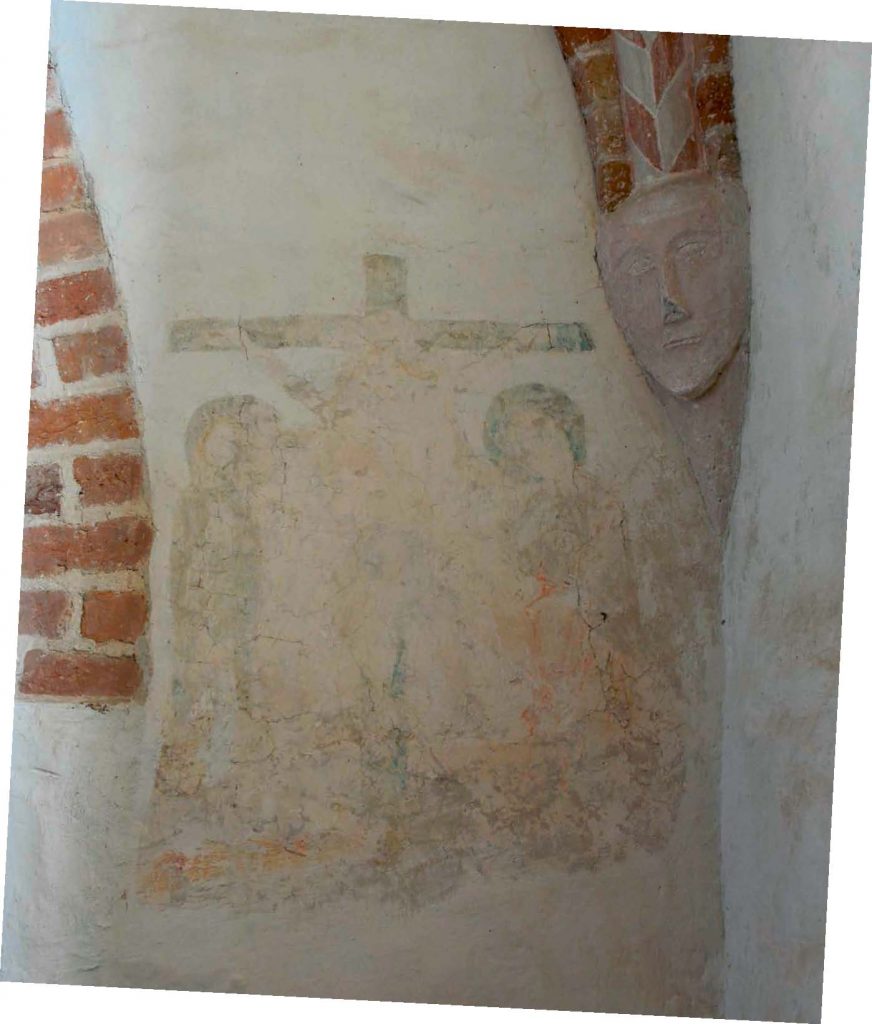
Below the wall frescoes, which probably date from the church’s second painting phase, there is a rectangle surrounded by ornamental lilies. When stones were removed from this spot during church renovations in 1964, workers found a round cavity that probably once contained a a relic.
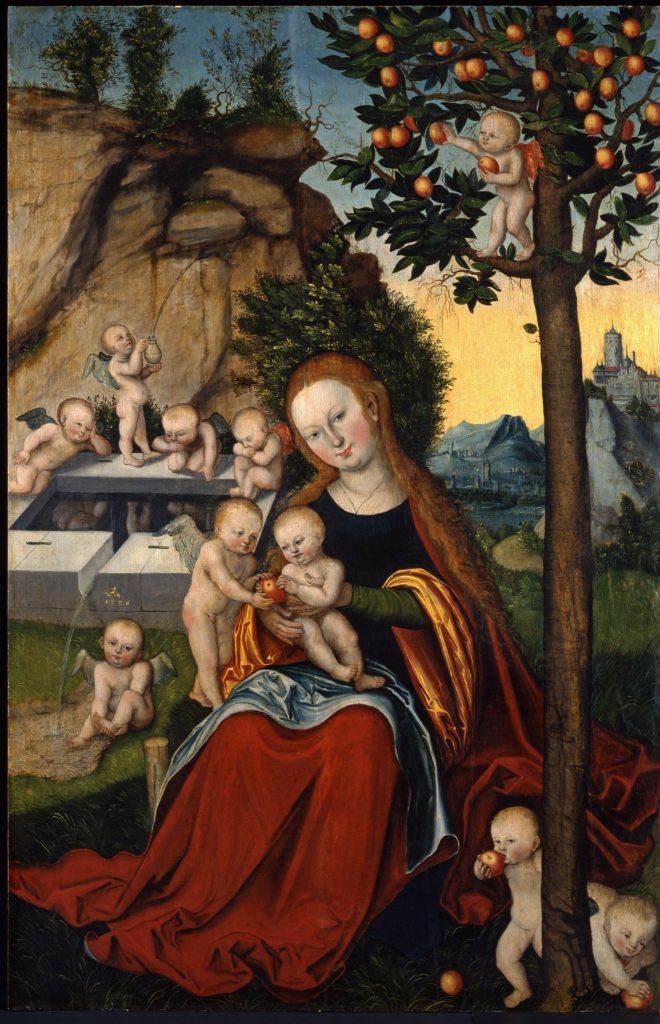
On the church’s north wall hangs a copy of the painting The Virgin under the Apple Tree by Lucas Cranach the Elder (1472-1553).
The original was probably acquired in about 1700 by the church’s patron, Count Ernst Christoph von Voß, and subsequently hung in the church.
In 1944, Pastor Heinz Büchner personally took the original painting, by then woodworm-infested, to Berlin by train. There it was restored in the Kaiser-Friedrich-Museum (now the Bode Museum).
Afterwards it was not returned to Groß Gievitz; instead it now hangs in Güstrow Palace. The painting, in oil and tempera on limewood, bears the winged serpent signature typical of Cranach and the year 1526.
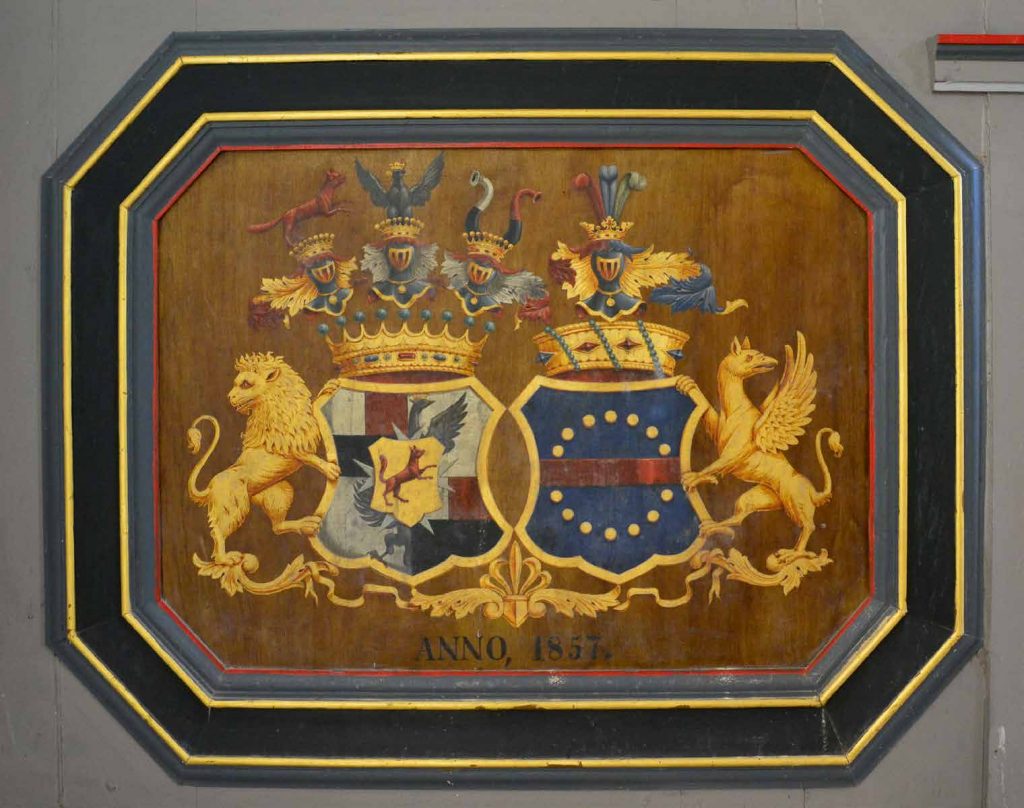
<- Back | Forth ->(1) Photo of the alliance coat of arms of the Counts of Voß and the von Berg family on the family pew. The von Berg family’s coat of arms looks a little like the flag of Europe: on the von Voß family’s coat of arms, as on that of Groß Gievitz, a red fox can be seen.
(2) Portrait of a saint, possibly St. Peter, Picture: Heidi Goerlt
(3) The Virgin under the Apple Tree by Lucas Cranach the Elder (1926). Photo: Gabriele Bröcker, © Staatliche Schlösser, Gärten und Kunstsammlungen M-V