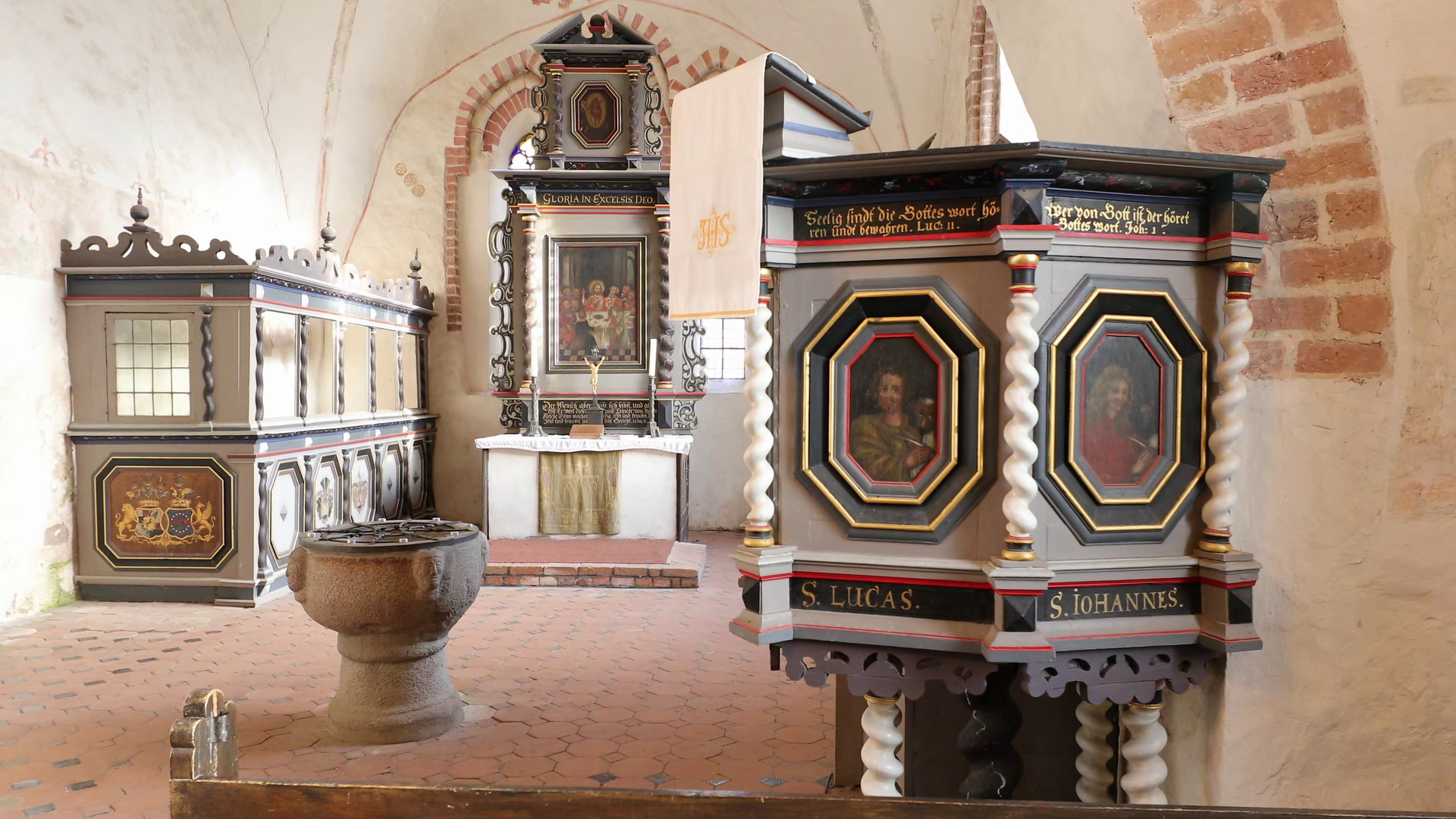
Some of the church furnishings are of Baroque origin; others are older than the building itself.
In 1692 Count Ernst Christoph von Voß (1655-1720) took over the Gievitz estate and became the patron of the church, which by that time was in disrepair. He initiated extensive repairs and had the church renovated in the Baroque style.
A little later, under Count Friedrich Ernst von Voß (1700-1738), a first organ was acquired. In the nineteenth century, the church furnishings, especially the altar, pulpit and gallery, were painted over, in keeping with the taste of the times, and in 1964 they were elaborately restored when the church was completely renovated.
After taking samples, a company in Waren was able to determine what the original colours had been, so that the furnishings‘ original Baroque colouring could be recovered.
Baptismal font
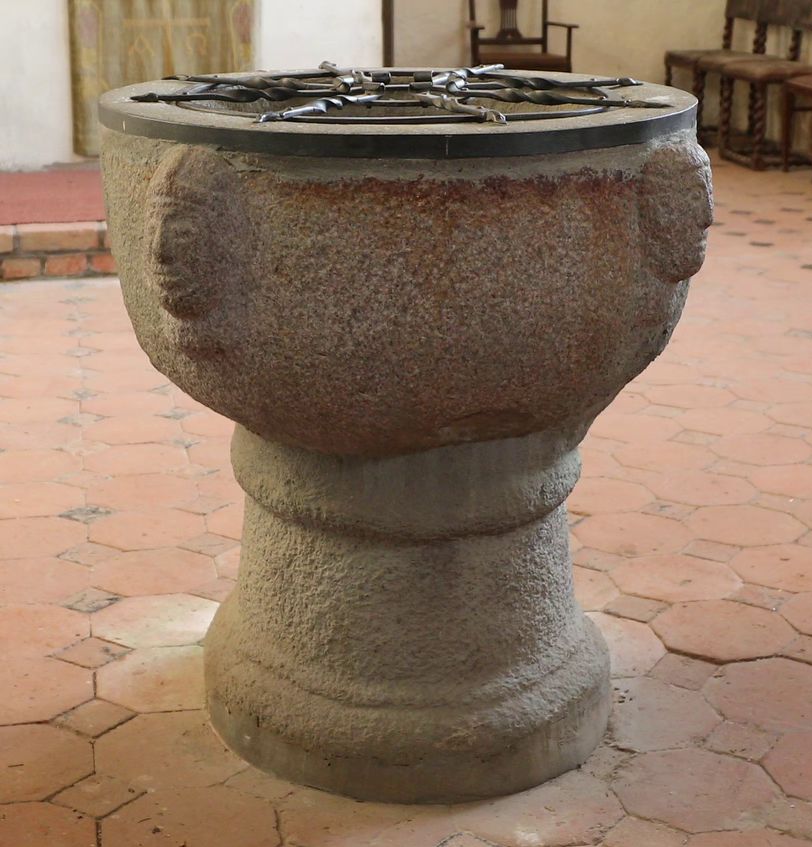
The Romanesque font is made of granite and is older than the church itself. It is possible that it had already been used in a (possibly wooden) church that preceded this one.
The font is decorated with four faces that might symbolise the various stages of life. In the mid-19th century it was placed outdoors, where it was exposed to the effects of weather for many decades.
Not until 1961 was it taken back into the church. In the same year a blacksmith made an iron latticework grate for the Baroque silver baptismal basin.
Altar
Two painted scenes are inset into the altar: the smaller, in its upper section, shows the resurrection of Jesus; the larger depicts the Last Supper.
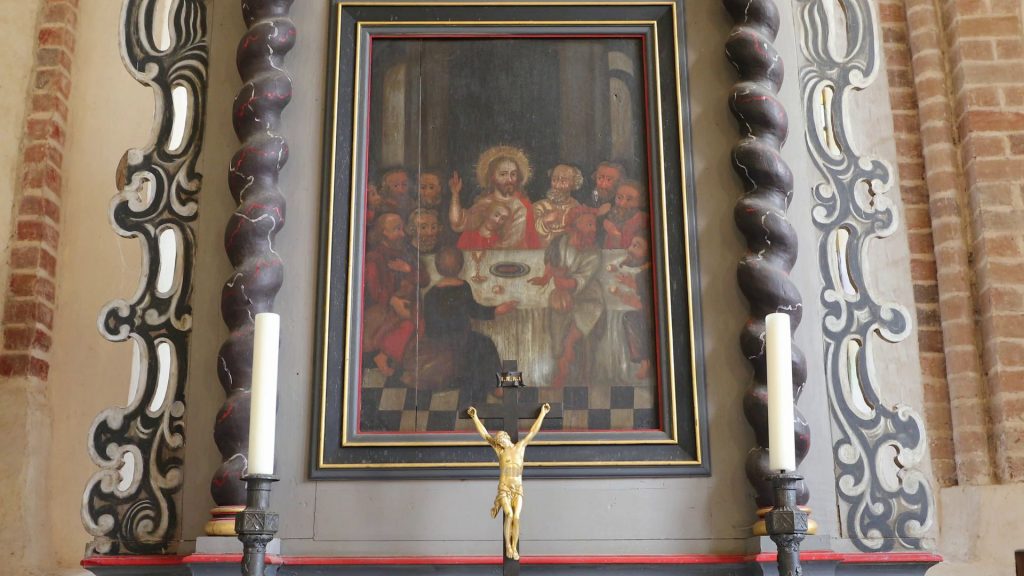
Here, Christ is in the centre, his hand raised in blessing. Leaning against his shoulder is John. In the foreground you can see the red-haired Judas Iscariot, his hand holding a pouch with silver coins. The bearded man to the right of Jesus is Peter. No other apostle has so many highlights on his robes – an indication that the artist attributed exceptional significance to him.
During renovations in 1857/58, both altarpieces were covered with other oil paintings, one of which showed a detail from Raphael’s “The Transfiguration”. Now the original paintings can once again be seen on the altar.
.
Crucifix
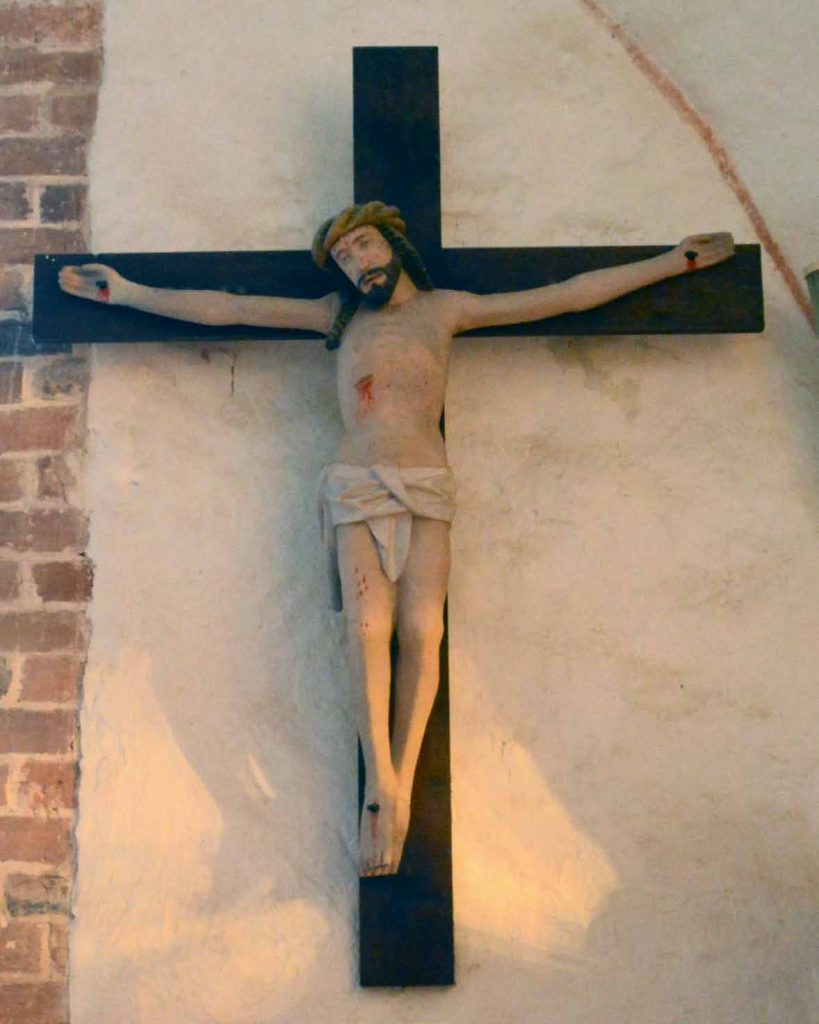
The cross above the door of the sacristy was evidently originally a free-hanging crucifix, which had its place behind the triumphal arch. In the part of the vaulting with the fresco that features four crosses, you can still see two holes in the wall, edged in red.
The crucifix is older than the rest of the church furnishings. The painting on the Christ figure is probably of more recent origin.
Church patrons‘ family pew
The pew for the patrons of the church was in the possession of the von Voß family. The members of this venerable family of counts had their own separate entrance and a raised pew, so that they were in an elevated position when attending services.
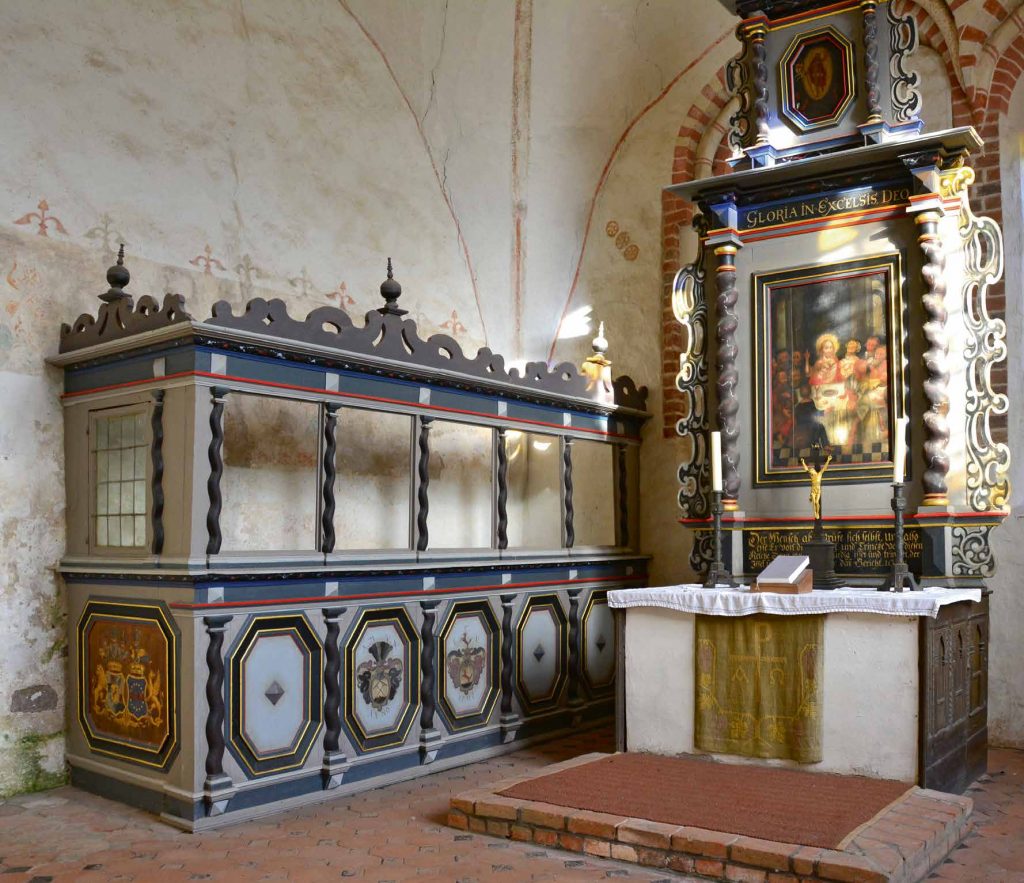
During the course of restoration in 1964, the pew was lowered and the entrance walled up. The wall painting with the three small wheels probably indicates the coat of arms of another family of benefactors.
Preacher’s pulpit
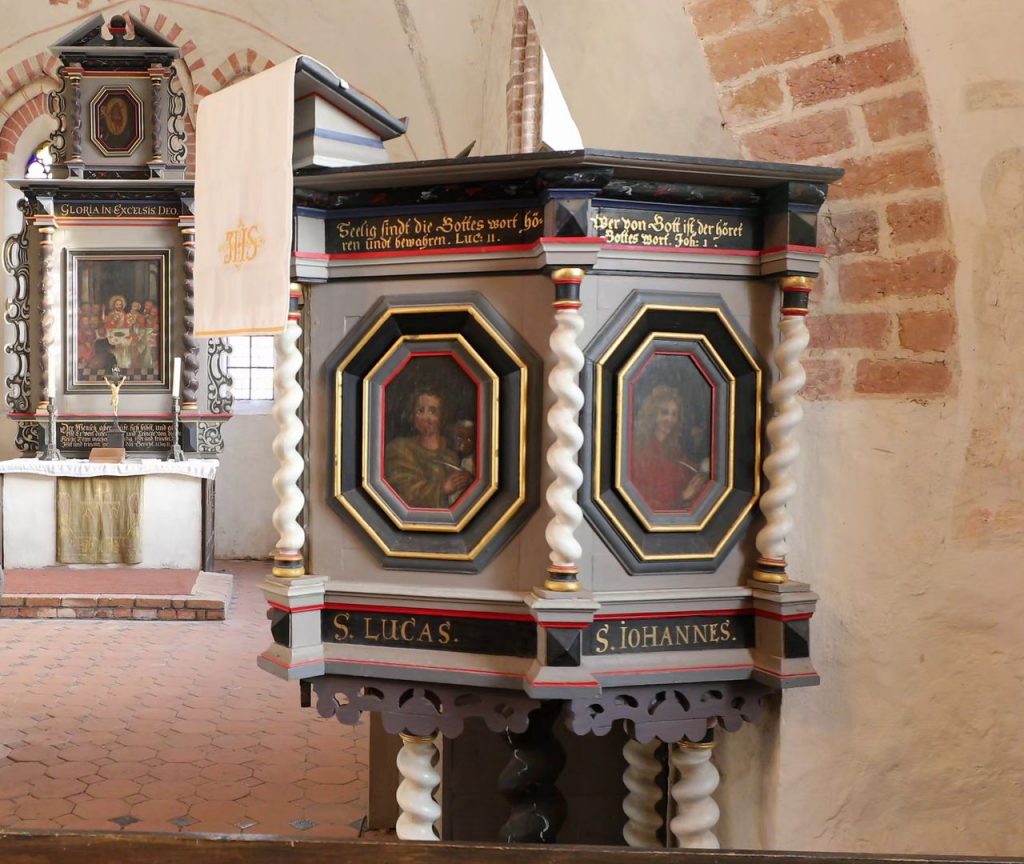
The pulpit is decorated on its four sides with the four Evangelists and their attributes. Above each Evangelist is a quotation from his particular gospel.
The first, on the left, is Matthew. Above him is written: “This is my beloved Son, in whom I am well pleased; hear him“ (Matthew 17:5). The second is Mark, with the words: “If anyone has ears to hear, let him hear “ (Mark 4:23). As third, Luke follows with: “Blessed are they that hear the word of God, and keep it” (Luke 11:28), and last comes John with the inscription: “He who is of God hears God’s words” (John 8:47).
Above the door to the pulpit stands “Soli Deo Gloria” (Glory to God alone), a exhortation to the preacher to deliver his sermon in the sign of the dove – in other words, under the guidance of the Holy Spirit.
Gallery
The gallery was enlarged when the Lütkemüller organ was newly acquired in 1858. It was originally decorated with 14 paintings: of the 12 apostles, Christ the Redeemer (“Salvator mundi”), and John the Baptist.
Two of the panels were removed to build a gallery on the north wall, which was later dismantled. To date, the two paintings, which depicted the apostles Jude Thaddaeus and Thomas, have not been found again.
<- Back | Forth ->(1) Baptismal font
(2) Altarpicture
(3) Cruzifix
(4) Church patrons‘ family pew
(5) Preacher’s pulpit